Bosnia and Herzegovina
Mostar
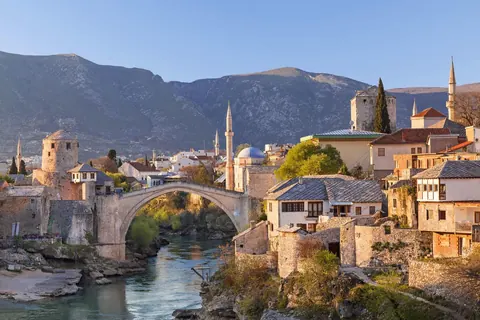
Mostar is a picturesque and historically dramatic city in southern Bosnia and Herzegovina, located in the deep canyon of the Neretva River in the Herzegovina region. The city, where Ottoman and Austro-Hungarian cultures intertwined for centuries, is today known as the main cultural and architectural symbol of the country.
Mostar is famous for its recreated 16th-century Old Bridge, the emerald waters of the Neretva, Ottoman narrow streets, ancient mosques and the tradition of diving from dizzying heights.
How to get to the city
By public transport
⚬ Train: One of the most beautiful panoramic train routes in Europe runs from Sarajevo (Pasažirski train). Travel time is about 2 hours.
⚬ Bus: Regular services connect Mostar with Sarajevo, Split, Dubrovnik and Kotor.
⚬ Cost: Train/bus from Sarajevo - about 15–20 BAM (8–10 EUR) one way.
⚬ ⚠️ Tip: For international bus routes (to Croatia or Montenegro), buy tickets in advance and allow extra time for border control.
The Old Bridge (Stari Most) is a masterpiece of 16th-century Ottoman architecture, designed by a student of the great Sinan, Mimar Khairuddin. Destroyed during the Bosnian conflict in 1993, the bridge was painstakingly rebuilt from local stone blocks and reunited the two banks of the Neretva in 2004, becoming a UNESCO World Heritage Site and a symbol of reconciliation.
What to see
Old Bridge (Stari Most)
The main dominant feature of the city with a majestic stone arch over the Neretva and the best views of the historical center.
Koski Mehmed Pasha Mosque
Ottoman mosque of the 17th century. From the top of its minaret the same classic panorama of the Old Bridge and the river opens.
Old Bazaar (Kujundžiluk)
A colorful oriental market with stone pavements, copper minters, coffee shops and souvenir shops.
Crooked Bridge (Kriva Ćuprija)
A smaller miniature copy of the Old Bridge over the Radobolya River, built several years earlier as a test project.
House of Kaytaz (Kajtazova Kuća)
An authentic residential complex of the 16th century, which has preserved the original interior, courtyard and life of the Ottoman era.
Franciscan monastery and bell tower (Franjevački samostan)
A Catholic complex with a high bell tower, on top of which there is an observation deck with a 360° view.
Karagöz Bey Mosque
The largest and most architecturally significant mosque in Herzegovina, built in the 16th century according to the design of Mimar Sinan.
Muezin Tower and Brus Park (Fortica Hill)
An observation deck and glass skywalk (Skywalk) on Fortitsa Hill above the city, offering views of the entire valley.
Museum of the Old Bridge (Muzej Starog Mosta)
A museum in the Tara Tower, dedicated to the history of the construction, destruction and restoration of the country's main bridge.
Source of the Buna River in Blagaj (Blagaj Tekija)
12 km from Mostar there is a mystical dervish monastery (Tekija) of the 15th century at the foot of a giant rock, from under which a powerful karst spring flows.
Jumping from the Old Bridge into the icy emerald Neretva from a height of 24 meters is a tradition with a 450-year history. Local daredevils from the Jumpers Club (Ikar) gather spectators on the bridge and perform spectacular jumps. Every summer, one of the stages of the Red Bull Cliff Diving world championship takes place here.
Where to stay
Hotel Kriva Ćuprija
Atmospheric boutique hotel in a historic stone building right next to the Crooked Bridge in the center of the Old Town.
Muslibegović House
A unique hotel-museum in a real mansion of the Ottoman nobility with a national courtyard and antique furniture.
Mostar is a city of contrasts, where the minarets of Ottoman mosques (such as the Koski Mehmed Pasha Mosque) rise above tiled roofs on one side of the river, and the bell tower of a Catholic Franciscan monastery on the other. This is a place where the oriental spirit of the Ottoman Empire harmoniously combines with the European heritage of Austria-Hungary.
Where to eat
Šadrvan
Traditional restaurant in the Old Town with waiters in national costumes. They serve excellent sahan (assorted Bosnian dishes), cevapi and juicy meat.
Tima-Irma
Legendary family-run Chevabdzhinitsa in the heart of the bazaar, famous for its huge plateaus of meat, fresh somun flatbreads and soulful service.
The city is surrounded by rugged karst mountains, and the Neretva River is known for its unusual emerald-turquoise color and icy water. Mostar is famous for its heat in the summer months, cozy restaurant terraces right next to the water, the aroma of freshly brewed Bosnian coffee and traditional Balkan grills.
Places map
👀 What to see
🛏️ Where to stay
🍽️ Where to eat
Additional info
Practical information and history
⚬ History and name of the city: The name Mostar comes from the word mostari (“bridge guardians”) - this is how the guards who guarded the main wooden and then stone bridge across the Neretva were called in the Ottoman era.
⚬ Climate and features: Mostar is one of the hottest cities in Europe. In summer, the air temperature regularly exceeds +40 °C, so the ideal time to walk along the cobbled streets is early morning or evening, when the heat subsides.
What else should be included in the program
⚬ Kravica Waterfalls: About 40 km from Mostar there is a large-scale natural amphitheater with a cascade of waterfalls about 25 meters high, where in summer you can swim in cool emerald water.
⚬ Fortica Park: A hill above Mostar with breathtaking panoramic views of the entire valley, a transparent glass bridge (Skywalk) and the longest zipline in Bosnia and Herzegovina.
Photos
Live here
No one from the community has marked this city as home yet.
Have been here
No one from the community has marked this city as visited yet.
Mark your own city in My places →