Bosnia and Herzegovina
Jajce
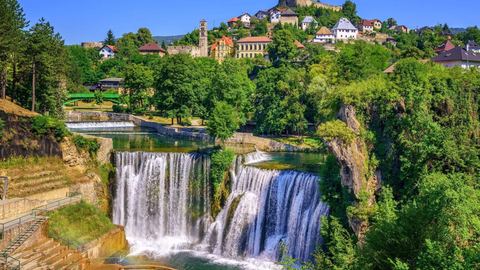
Jajce is a unique historical town in central Bosnia and Herzegovina, located at the confluence of the Pliva and Vrbas rivers. This is the only city in the world in the very center of which there is a natural 20-meter waterfall. Jajce was of key importance in the history of the Balkans: it served as the last capital of the medieval Bosnian kingdom and the birthplace of modern Yugoslavia.
The city is famous for its Pliva waterfall, a medieval fortress on a hill, underground catacombs and a unique complex of ancient wooden watermills on the Pliva River.
How to get to the city
By public transport
⚬ Bus: Regular intercity services connect Jajce with Sarajevo, Banja Luka, Mostar and Bihac.
⚬ Cost: Bus from Sarajevo or Banja Luka - about 15–25 BAM (8–13 EUR) one way.
⚬ ⚠️ Tip: The road from Banja Luka passes through the narrow and incredibly beautiful Vrbas canyon; Plan your trip during daylight hours to enjoy the views.
The main visiting card of Jajce is the Pliva waterfall (Vodopad Plive), where the transparent Pliva River falls from a 20-meter height into the stormy waters of Vrbas. The waterfall is located right at the foot of the Old Town, and at its base there is an observation deck, which offers a breathtaking view of the powerful water cascade.
What to see
Pliva Waterfall
One of the most beautiful urban waterfalls in the world with an equipped observation deck at the foot.
Medieval fortress Jajce
A powerful citadel on the top of a hill with preserved stone walls, the coat of arms of the kings and a panorama of the city.
Wooden mills Mlinčići
A complex of 20 miniature Ottoman watermills on a tuff threshold between lakes.
Catacombs of Jajce
An underground crypt and church carved into the rock at the turn of the 14th–15th centuries by order of Duke Hrvoje Vukčić Hrvatinich.
Bell Tower of St. Luke and St. Mary's Church
Ruins of a medieval church and the only original Romanesque Gothic bell tower in the Balkans.
AVNOJ Session II Museum
A historical museum in the building where the creation of federal Yugoslavia was proclaimed in 1943.
Plivo Lakes
Picturesque lakes with turquoise waters, ideal for boating, swimming and picnics.
Bear Tower
A massive round defensive tower from the 15th century, used in the defense system of the Old Town.
Esma Sultan Mosque
A unique 18th-century Ottoman mosque in the city center, named after the wife of the Bosnian Pasha.
Kravica and the Vrbas River Canyon
A picturesque canyon with steep cliffs and rushing water, starting just beyond the northern outskirts of the city.
Surrounded by green hills and canyons, Jajce offers excellent conditions for outdoor recreation: from swimming and boating and SUP boarding on the surface of the Plivske Lakes to fly fishing, rafting on Vrbas and walking along mountain trails.
Where to stay
Hotel Plivsko Jezero
The hotel is on the very shore of the Great Plivo Lake with its own park, pier and panoramic restaurant.
Hotel Turist 98
Comfortable classic hotel in the city center within walking distance of the waterfall and the Old Town.
The Big and Small Plivska lakes (Plivska jezera) are located 5 kilometers from the city center. On the bridge between the lakes, a rare complex of two dozen miniature wooden water mills (Mlinčići), built in the Ottoman era for grinding wheat, has been preserved.
Where to eat
Restaurant Plivsko Jezero
A panoramic restaurant by the lake, where freshly caught river trout and traditional Bosnian meat dishes are excellent.
Restaurant Kod Kmeta
A traditional establishment within walking distance from the center: generous portions of cevapi, pljeskavica and homemade pastries.
Jajce entered world history on November 29-30, 1943. At the height of World War II, the Second Session of the AVNOJ (Anti-Fascist Assembly for the People's Liberation of Yugoslavia) under the leadership of Josip Broz Tito took place here, where the foundations of a federal Yugoslavia were laid.
Places map
👀 What to see
🛏️ Where to stay
🍽️ Where to eat
Additional info
Practical information and history
⚬ Royal Cathedral and Tomb: Jajce was the place where the relics of St. Luke the Evangelist were kept, which came here in the 15th century as the dowry of the Serbian princess Maria and were in the city until the Ottoman conquest.
⚬ Architectural phenomenon of tuff: The rapids of the Pliva waterfall and the cascades near the mills are formed from soft calcite tuff (travertine). Regular work is being carried out to strengthen and protect the river bed in order to preserve the natural structure of the waterfall.
What else should be included in the program
⚬ Glass bridge and observation deck on Vrbas: A new observation deck at the exit from the city towards Banja Luka, which offers an excellent view of the confluence of two rivers and the canyon.
⚬ Janjške Otoke Nature Reserve: About 40 km from Jajce in the Šipovo region there is a unique nature reserve where the Jan River splits into dozens of small channels, waterfalls and islets among dense forest.
Photos
Live here
No one from the community has marked this city as home yet.
Have been here
No one from the community has marked this city as visited yet.
Mark your own city in My places →